
Introduction — What a laser fume extractor actually does
I’ll start by defining the piece of equipment we’re talking about: a laser fume extractor is a device that captures and filters airborne contaminants produced during laser cutting, engraving, or welding. In many shops, a laser fume extractor is the only thing between clean air and a workshop full of fine particles and volatile organic compounds. Picture this: a mid-size fabricator runs three 1.5 kW lasers eight hours a day; particle counts near the workstations spike to tens of thousands of particles per cubic meter and VOC sensors show periodic peaks above safe thresholds. That data forces a question — how do you pick a system that truly protects workers and keeps production steady? (I’ve seen this play out in small shops and in larger OEM lines — the stakes are real.)
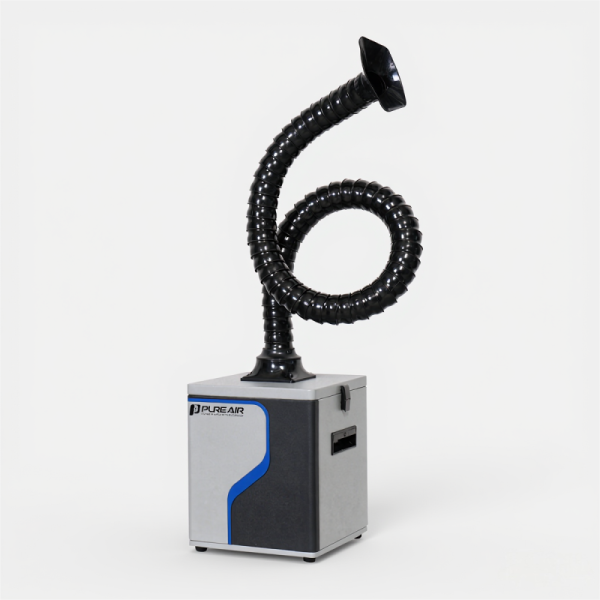
Let me be blunt: performance is not marketing. You need to read airflow specs, filter ratings, and capture velocity numbers the way an engineer reads a wiring diagram. I’ll walk through the common failure modes, what they mean on the floor, and then show how new design principles change the game. This is practical, not theoretical. Next, I’ll explain why many traditional solutions fail to meet day-to-day shop needs.
Part 2 — Why many laser fume extraction systems underperform
The simple truth: most systems look good on paper but fail where it matters. When I test laser fume extraction systems, I often find that stated CADR or nominal airflow hides real weaknesses like poor capture velocity at the nozzle and inefficient filter staging. Look, it’s simpler than you think — a fan can move air, but if the capture hood, ductwork, or face velocity is wrong, contaminants escape. HEPA filters and activated carbon beds are useful, but they don’t fix bad placement or low inlet velocity. In short: you can have excellent particulate filtration but still expose operators to VOC spikes and ultrafine particles if the system’s airflow path is poorly engineered.
How do these failures show up on the shop floor?
First, there’s the false sense of security. Managers see a filter efficiency percentage and assume the air is safe. Second, maintenance gaps: clogged pre-filters, saturated carbon, and reduced fan output lower performance quickly. Third, integration issues: many units require ductwork or external exhaust that alters pressure balance and disrupts process air — you get drafts, inconsistent capture, and more downtime. I’ve documented cases where particulate filtration was rated at 99.97% (true HEPA), yet operators still reported odors and eye irritation. That tells me the system’s capture velocity and local exhaust design were the true culprits — not the filter media. These are engineering problems, not marketing problems — and they deserve practical fixes.
Part 3 — New principles and practical metrics for future-ready systems
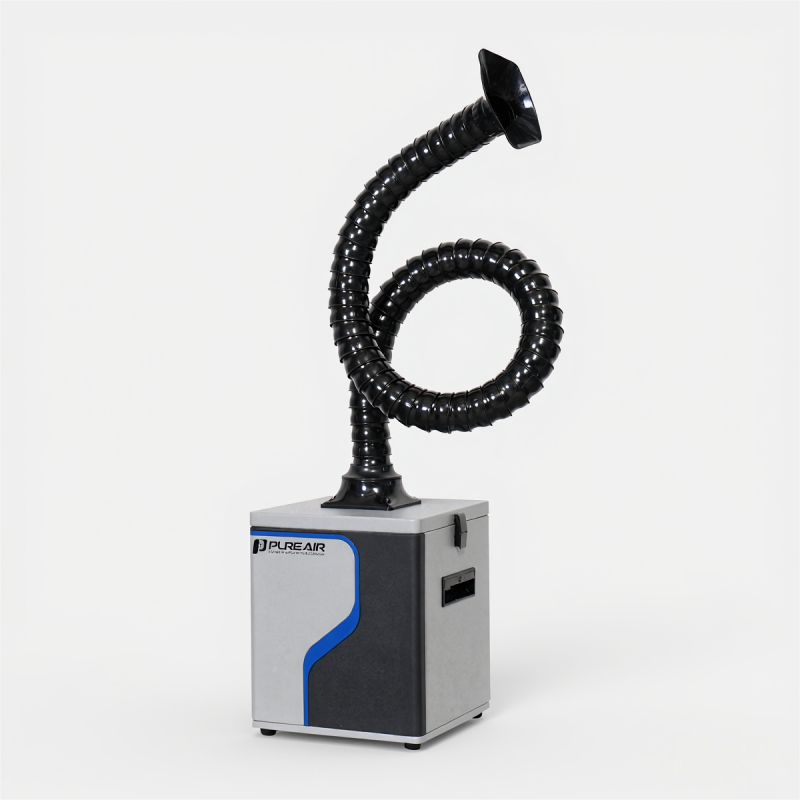
What’s next? New designs focus less on a single big filter and more on system-level performance. Modern units pair staged filtration (pre-filter + HEPA + activated carbon) with smart control of airflow and local capture hoods. When I evaluate a system now, I look for modular filter banks, variable-speed blowers, and sensors that track pressure drop across stages. These elements let you maintain required airflow and predictable capture velocity as filters load. Also, closed-loop control and local extraction arms improve capture without over-ventilating the whole shop — reducing energy use while keeping air clean. This shift is about systems thinking: fan, duct, hood, filter, and controls must work as one.
Real-world design principles
There are clear technical moves that help: ensure hood geometry supports an inlet velocity appropriate for the process; size fans to maintain that velocity even as filters load; specify filter media by contaminant type (particulate vs. VOC); and include accessible maintenance points so operators actually change pre-filters on schedule. I encourage teams to run simple field checks — smoke pencil tests at the hood, differential pressure reads across filter stages, and periodic particle counts at operator height. These checks are low-cost and very telling. — funny how that works, right?
To close, here are three metrics I use to evaluate any extraction system: 1) Effective capture velocity at the point of emission (measured in m/s), 2) System-level airflow under loaded filter conditions (m3/h), and 3) Total cost of ownership including filter replacement frequency and energy use. Use these when you compare vendors and when you write your purchase specs. If you want practical, field-tested solutions, consider vendors that publish measured capture tests and offer modular designs — that’s where I turn first. For reference and supplier options, see PURE-AIR.