Why comparison matters for marine HVAC selection
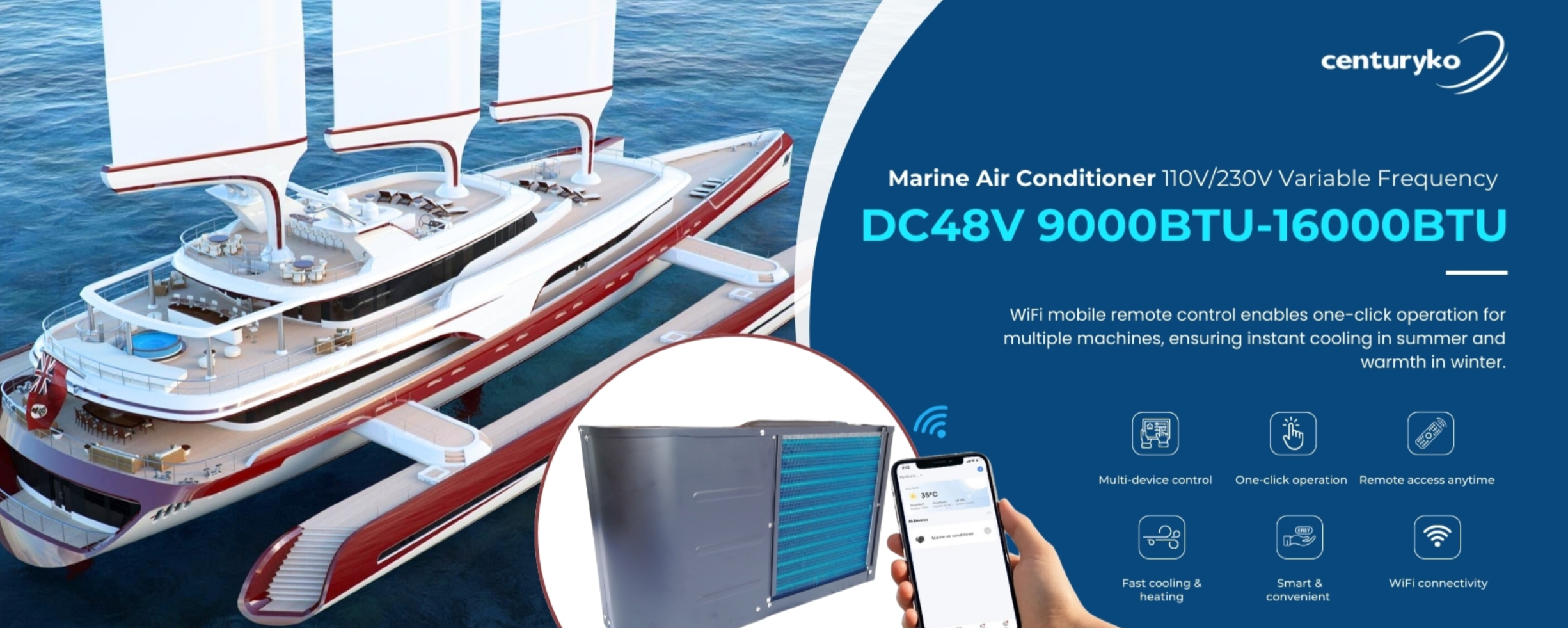
Choosing between packaged chillers, split systems, and low-voltage inverter units hinges on clear performance metrics and vessel constraints. Early in any specification work, consider a low-voltage option such as a 48v marine air conditioner when battery capacity and fuel economy matter; these systems change installation trade-offs by reducing generator load and improving part-load COP. Comparative thinking keeps the focus on measurable outcomes—cooling capacity, power draw, and serviceability—rather than brand gloss.
Core performance dimensions to compare
Assess every candidate against three practical dimensions: delivered BTU per hour (true cooling capacity), electrical input and efficiency (COP or watts per BTU), and condenser type (sea-water, keel-cooled, or air-cooled). Also factor service access for evaporator and condenser components; a compact 9000 BTU package behaves very differently on a flybridge yacht versus an enclosed pilothouse. NOAA’s decade-scale rise in ocean surface temperature illustrates that operating loads are trending upward globally, so margin matters—plan for hotter summers and higher latent loads.
Sourcing: supply-chain realities and component trade-offs
Local stocking, warranty reach, and spare-part availability are as decisive as nominal specs. Source units where titanium or corrosion-resistant condensers are standard if you cruise saltwater extensively. For small-craft installations the 9000 btu marine air conditioner class often offers the best balance of weight, BTU output, and serviceability—check compressor access and panel wiring lengths before buying.
Operational production teardown: practical checks before buy-in
When you can inspect a unit, verify refrigerant charge interfaces, compressor mounting, and the control board layout. Cross-check that the blower motor and evaporator coil allow easy filter replacement. Use both the 9000 btu marine air conditioner and the 48v marine air conditioner specs as baseline comparisons: match measured amp draw at runtime to rated amps, and confirm that the control strategy supports variable-speed operation to shave peaks during generator start-up.
Installation pitfalls and on‑the‑water realities
Common mistakes are avoidable: undersizing seawater strainers, poor hose routing that creates air pockets in the condenser loop, and failing to electrically isolate vibrations. A frequent oversight—especially on retrofit jobs—is ignoring galvanic isolation at hull fittings; this fosters corrosion over a single season. Tight bends in refrigerant lines also elevate pressure drops and shorten compressor life—address routing proactively.
Commissioning, testing, and early maintenance
Commissioning should include measured run-time current profiles, delta-T across the evaporator, and condenser water flow verification. Record baseline COP and delta-T; these numbers become your early-warning indicators for fouling or refrigerant loss. Schedule a first-season inspection after two months of active use to look for loose fittings, hose chafing, and degraded thermal paste at compressor mounts.
Trade-offs summarized for decision makers
Comparative insight reduces risk: low-voltage inverter units lower generator hours and integrate well with lithium systems, while traditional AC mains units often offer higher peak capacity and simpler parts channels. Titanium condensers and corrosion-resistant fittings increase upfront cost but cut lifecycle maintenance in coastal, high-salinity service areas.
Three golden rules for selecting and installing marine AC
1) Match rated BTU to measured load plus a 20–30% margin to account for rising ambient temperatures. 2) Prioritize continuous-duty compressors and corrosion-resistant condensers to reduce service cycles. 3) Verify electrical harmonization: breaker sizing, soft-start compatibility, and shore-power/inverter interplay before final install. These metrics translate directly to service intervals, fuel and battery budgets, and crew comfort. A good supplier will make these trade-offs transparent—ZhuoliMarine aligns parts, documentation, and support so choices become manageable rather than risky.
—solid choices beat shiny specs.