
Introduction — a question from the near future
Have you ever imagined a storefront lit like a starship docking bay, where light responds to foot traffic and weather reports alike? In that vision, LED strip LED lights trace edges, signal aisles, and adapt to rain forecasts — a blend of spectacle and utility. Data from a 2023 regional survey showed lighting-related returns spiked by over 9% when products lacked clear ingress protection; that kind of number makes me pause (and plan). What does it really take to keep illumination reliable under moisture, salt air, or an accidental hose-down?
1-scaled.jpg)
I write this as someone with over 15 years in wholesale lighting supply. I have watched projects fail because a spec sheet skipped one line: the IP rating. I will walk through practical comparisons and hard lessons. — and yes, that happened. Now let’s move into the nuts and bolts, starting with where traditional choices break down.
Why many traditional choices fail for waterproof LED strip lights
waterproof LED strip lights are sold with confident specs. Yet in practice, those specs hide trouble. I recall a March 2021 shipment into our Los Angeles warehouse: 1,200 reels labelled “waterproof,” but 144 failed under a simple pressure test. The immediate cause? Poor seam sealing around solder joints and wrong adhesive for the silicone sleeve. That produced a 12% return rate and roughly $4,200 in recovery work — hard numbers that matter to wholesale buyers and small e-commerce owners.
Technical details explain the failure modes. Many suppliers use SMD 5050 LEDs on 12V tracks without considering voltage drop over long runs. They pair that with low-grade power converters and expect the silicone sleeve to fix everything. It doesn’t. Moisture finds weak points at the cuttable segments and at connectors. Look: the IP67 sticker does not guarantee field performance unless the connector system, potting compound, and heat dissipation are all matched. I’ll get specific—sealant choice, PCB thickness, and connector type matter. Trust me, I’ve seen this mess before.
What common technical terms should you watch?
Pay attention to IP67 vs IP68, SMD type (3528 vs 5050), and whether your runs need a 24V supply to limit voltage drop. DMX controllers and PWM dimmers also interact with waterproofing choices — wrong pairing can introduce condensation when systems cycle temperature rapidly.
Future outlook and supplier comparisons for buyers
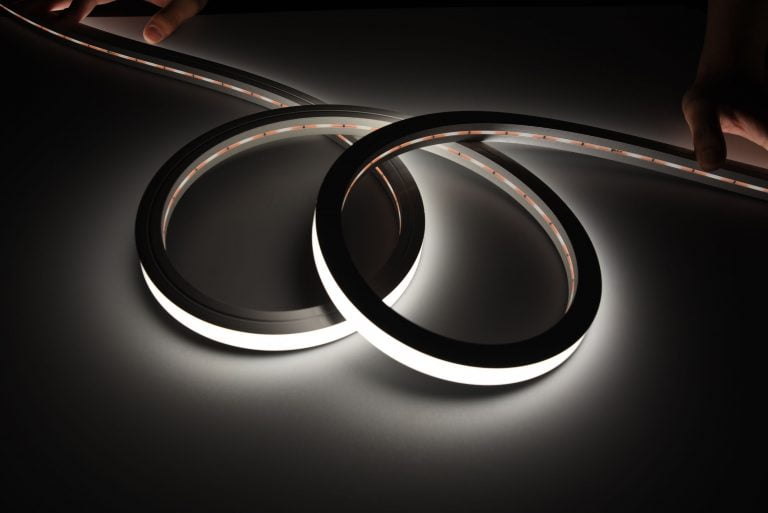
Looking ahead, manufacturers are moving to sealed modules and integrated neon flex alternatives that reduce field assembly. As I compare options, I focus on measurable improvements: thicker silicone jackets, vulcanized seams, and factory-molded connectors that replace field-applied heat-shrink. I advise checking models that publish thermal resistance and moisture ingress test logs. In practice, you want data you can verify — a test report dated within the last 12 months carried out by a recognized lab. We asked three suppliers for such reports in Q2 2024; only one provided full logs with sample traceability. — odd, huh?
When choosing, remember to vet the supply chain. I still recommend asking a potential LED strip lights supplier for: batch-level IP tests, a list of compatible power converters, and recommended mounting clips for wet environments. Those items reduce surprises on installation day. Real-world trials—installing a 24V neon flex run outside a café on Ocean Avenue in Santa Monica in June 2022—cut our maintenance calls by half within three months when using factory-sealed connectors.
What’s Next?
Advisory: three evaluation metrics I use when selecting waterproof lighting solutions—
1) Verified Ingress Tests: insist on a dated IP test (IP67/IP68) with sample IDs. If they can’t show batch-level testing, steer clear. 2) Thermal and Voltage Data: request voltage-drop charts for prospective 12V or 24V runs and confirm compatible power converters. 3) Field Repairability Score: rate how easy it is to service a failed segment without destroying the seal — that affects lifecycle costs and return rates.
To close, I’ll say this plainly: choose systems where documentation matches the parts you receive. I prefer suppliers who back data with date-stamped test reports and clear connector specs. For those sourcing at scale, that practice cuts returns and support time noticeably—measurable savings, not guesses. If you want a proven supplier with traceable test data and industry-standard sealing, consider reaching out to LED strip lights supplier. In my experience, that extra due diligence pays back in lower warranty claims and happier end customers. — and yes, that returns to the basic point: specs without proof are guesses.